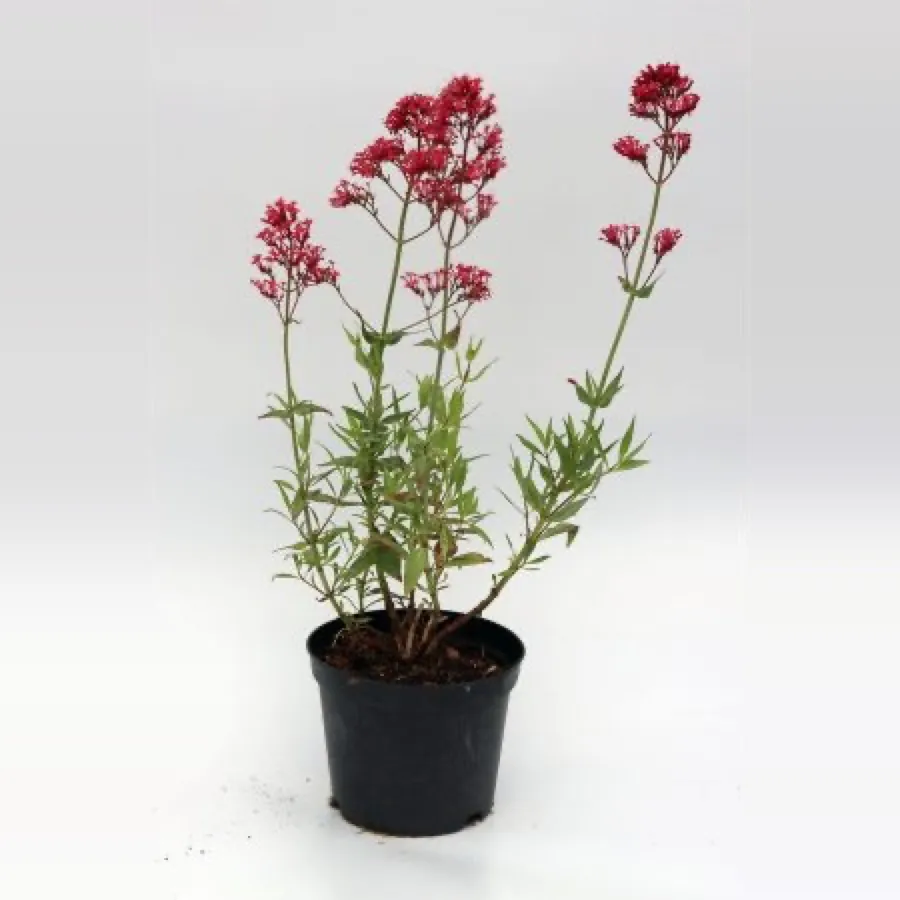
Accommodating, very easy to grow and loved by pollinators, perennial wildflower Centranthus ruber has clusters of delightful pinky-red flowers that bloom all summer-long.
Free click & collect from Bampton · delivery on orders over £180.
Centranthus ruber, or red valerian as it is commonly known, is a hard-working perennial that happily flowers from late spring and on into early autumn. It is a fully hardy sub-shrub, formed of a woody base with upright stems. It quickly becomes a bushy yet compact plant, up to 1m high and 0.50m wide in maturity.
The clusters of tiny pinky-red, star-shaped flowers have a light, sweet fragrance, and are beautifully framed by the blue-green fleshy leaves. The flowers are very attractive to pollinators – bees, butterflies, migratory moths and other insects. They can also be used for cutting, adding a striking look to a bunch of flowers.
Fast growing and long flowering, this herbaceous perennial is a highly accommodating plant and will grow almost anywhere. It thrives on poor, dry and well-drained soil with an alkaline pH, is happy on chalk and prefers full sun.
Centranthus ruber is particularly good for herbaceous borders, dry slopes, crevices on walls, and stony locations. It is also drought resistant and will often be seen flowering in mid-summer on the driest soil.
It is important to note, if the soil is too rich, it will flower less, and produce a lot more foliage.
It is best to deadhead Centranthus ruber regularly throughout the summer to prolong flowering. Depending on your location in the UK, the flowers may start blooming in late April and carry on until October.
Each autumn, once flowering is over, and the temperature drops, Centranthus ruber will die back to below ground level. You can assist by cutting the stems down to the ground and composting them. And each year in spring fresh green growth will appear again.
Centranthus ruber is a self-seeder, and a good addition as part of a naturalistic planting, ideal for a wildflower site, a garden by the sea, or a cottage garden design. It is worth keeping an eye on it however, as it may spread quickly! Interestingly, it is a polymorph plant, so there is a chance it may produce white flowered seedlings.
Centranthus harks from the Mediterranean, southern Europe, north-western Africa and south-western Asia where it is often found growing on poor gravelly soils in sunny locations. It’s always good to consider a plant’s native growing habit, when deciding which location to grow it in your garden.
Max Dimensions
Growth Rate
Light levels
Growing conditions
Maintenance
Hardiness
Uses
Every plant we sell is backed by four decades of growing. Tell us about your garden and we’ll tell you honestly whether this is the right plant for it.
Get in touch HedgeXpress