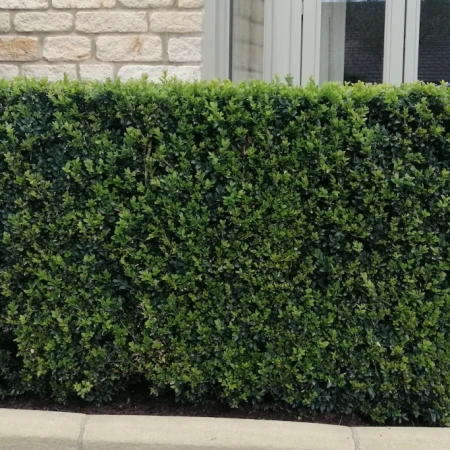
Common Box is perfect for forming a tight garden hedge or border hedge. It can be cut back hard and shaped easily.
Generally found on chalkland in the wild, common box plants are tough and will tolerate deep shade and are ideal for planting beneath taller trees. Yellow flowers appear from late winter onwards.
Our container hedging plants may be planted all year round and will soon become established. Clipped well and kept short, common box creates a smart internal garden hedge or decorative formal edging for a border or helps to soften a building.
Our recommendation is to space each plant 25 centimetres apart.
Free click & collect from the nursery, or delivery on larger orders.
Smart, elegant and screaming sophistication the Common Box (Buxus Sempervirens) makes for perfect garden edging or a dividing hedge. It is capable of forming a dense, tight, formal hedge in well drained soil in anything dense shade to full sun. It is slow growing, growing up to 10-15cm per year in favourable conditions. Common Box (Buxus Sempervirens) is a small evergreen shrub growing, if untrimmed, to between 4-8m tall and wide. The leaves are ovular and dark green with a leathery feel to them which are up to 3cm long and it has smooth, grey bark. Both genders of flower can be found on the same plant between April and May in yellow clusters.
Common Box (Buxus Sempervirens) is perfect situated for: city and courtyard gardens; cottage and informal; wildlife gardens; patio and container plants; hedging and screening and due to its tight nature, topiary.
Common box is fully hardy in the UK and has an RHS Hardiness rating of H6. It is capable of surviving down to -15 to -20C. Due to its tight nature it makes for the perfect windbreak, supplying vital cover to the garden which is essential to allow wildlife and other garden plants to survive.
In order for Common Box (Buxus Sempervirens) to keep its tight shape it should be trimmed twice a year in May and September. It is advisable to have a weak bleach solution when trimming and dip the shears in the solution so as to reduce the chance of any infections that might be present spreading.
Common Box (Buxus Sempervirens) is native to Europe, North Africa and West Asia and is thought to be native to the UK, though it is disputed. The most famous site where Box grows naturally in the UK is Box Hill in Surrey. It takes its name from the shrub which dominates the steep chalk woodland and has done since the 12th century and is an area of outstanding natural beauty.
Common Box (Buxus Sempervirens) timber is valuable commodity, being used for violin pegs, musical instruments and engraving and has long been sought after. It has been documented that in 1815 £10,000 of timber was removed from Box Hill, a huge fortune at the time. In early times the wood was used in religious festivals. Box wood is also incredibly valuable for medical purposes as it contains steroidal alkaloids. These are used in treatment for HIV, leprosy and epilepsy amongst other things.
Now to address the Elephant in the room, Box Blight; Box Blight is a fungal disease which can effect the common box and it can be spread in numerous ways. It enters the plant through wounds, for instance after pruning. The best way to deal with it is to keep the plant healthy, feeding it with seaweed extract. It can also be sprayed with various chemicals that can easily be found on the web, act sooner rather than later.
The same goes for the Box Caterpillar, treatments can easily be found on the web and are extremely easy to use.
Maintenance
Growing conditions
Light levels
Hardiness
Suitability to animals and wildlife
Buying a Hedge
Every plant we sell is backed by four decades of growing. Tell us about your garden and we’ll tell you honestly whether this is the right plant for it.
Get in touch HedgeXpress