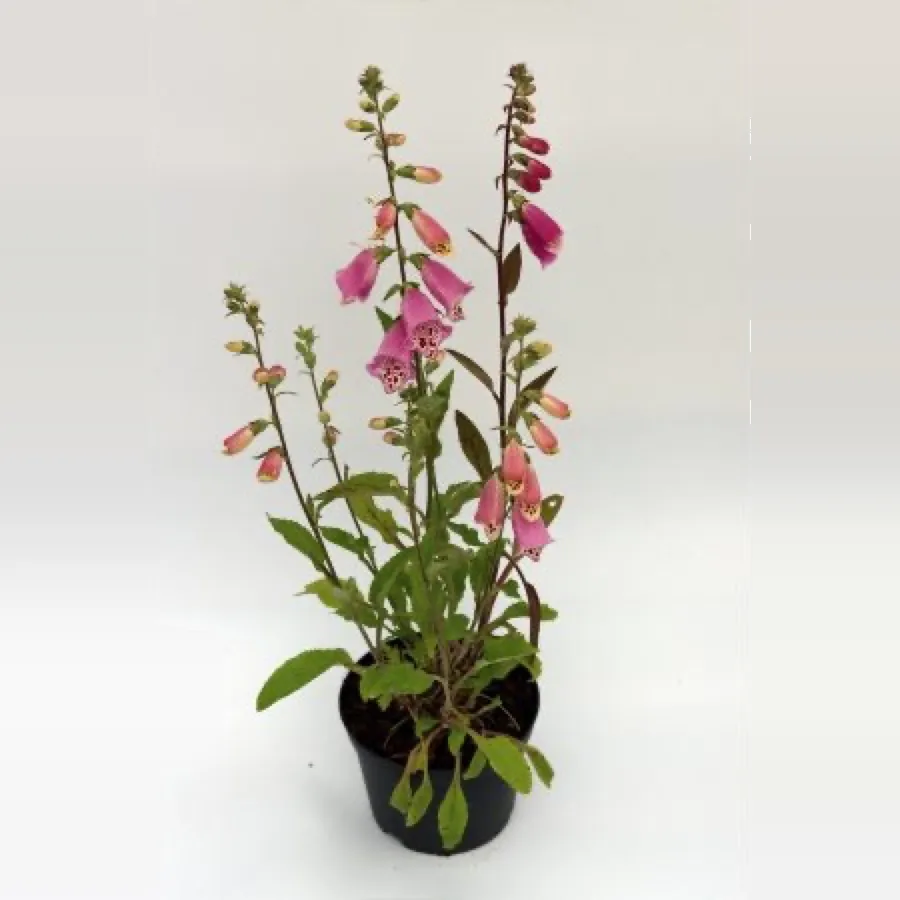
A beautiful summer flowering biennial and cottage garden staple, the tall spires of Digitalis purpurea, the common foxglove, are adorned with pretty pinky-purple tubular flowers.
Free click & collect from the nursery, or delivery on larger orders.
Digitalis purpurea, the common foxglove is a quintessential cottage garden plant. A beautiful flowering biennial, the tall spires of this upright plant will delight your garden throughout the months of June and July.
The distinctive pinky-purple tubular flowers are speckled with burgundy on the inside, attracting bees for pollination. Encircled by a rosette of oval green leaves, the common foxglove blooms from the bottom up, starting in June and continuing for several weeks.
The upright form makes Digitalis purpurea a good choice for formal borders, woodland plantings, and cottage gardens. The vertical flower spikes make a striking feature, adorned with their pretty nodding tubular flowers. At maturity, it may reach 2.5m high and 0.5m wide.
This hardy herbaceous perennial is perfectly happy in ordinary garden soil, even better if it is a little moist and well-drained, and it does enjoy a humus-rich environment.
Digitalis purpurea is content in full sun, but also happy with a little dappled shade. In the wild, in the UK, it is naturalised in forest clearings, so although it is known as a woodland plant, it tends to seek out the sun.
Best of all, it is loved by the bees, and is a very important plant for pollinators – a wonderful addition to any growing space.
It is important to note that foxgloves are biennials, in their first year they will form a rosette of leaves, and in their second year they will flower. The plants are potted in the first year and are ready from September ready to flower the year that you purchase them and will subsequently die over the winter after setting seed underneath themselves and the cycle is repeated.
Digitalis purpurea is a self-seeder, and if allowed to roam, foxgloves will arrange themselves in swathes, creating a picturesque natural planting, with little effort needed from the gardener.
All parts of Digitalis purpurea is poisonous, do not eat it. It is unlikely to do any harm just from touching it, but it is best to keep small children and pets away.
Every plant we sell is backed by four decades of growing. Tell us about your garden and we’ll tell you honestly whether this is the right plant for it.
Get in touch HedgeXpress