Hornbeam, otherwise known as Carpinus betulus is an incredibly versatile, hardy, semi-evergreen native hedge, capable of supplying privacy and reducing noise pollution. It is perfect for supplying cover for wildlife and due to its natural look, with its 5-8cm ribbed green leaves, with catkins in spring, it can easily create a soft backdrop into a field or grassland, being both animal and horse friendly with little to no toxicity reported. If left unchecked it will grow into a large deciduous tree with a grey trunk, though as a hedge it is often classed as semi-evergreen due to its ability to keep its old leaves into the winter and that it grows new leaves very early in spring.
Sold in several sizes — tell us what you need and we’ll confirm price and availability.
Hornbeam, otherwise known as Carpinus betulus is an incredibly versatile, hardy, semi-evergreen native hedge, capable of supplying privacy and reducing noise pollution. It is perfect for supplying cover for wildlife and due to its natural look, with its 5-8cm ribbed green leaves, with catkins in spring, it can easily create a soft backdrop into a field or grassland, being both animal and horse friendly with little to no toxicity reported. If left unchecked it will grow into a large deciduous tree with a grey trunk, though as a hedge it is often classed as semi-evergreen due to its ability to keep its old leaves into the winter and that it grows new leaves very early in spring.
Here, at HedgeXpress, located near Bampton on the Oxfordshire-Gloucestershire border, we admire Hornbeam (Carpinus betulus) for its versatility and resilience. This comes from a variety of factors. Being capable of surviving in waterlogged conditions, providing it is not for extensive periods of time. It is also exceptionally hardy, having an RHS hardiness rating of H7 meaning it can survive down to <-20c. It can survive exposed conditions making for a resilient hedging plant. The majority of RHS Wisely’s hedging for this very reason was hornbeam.
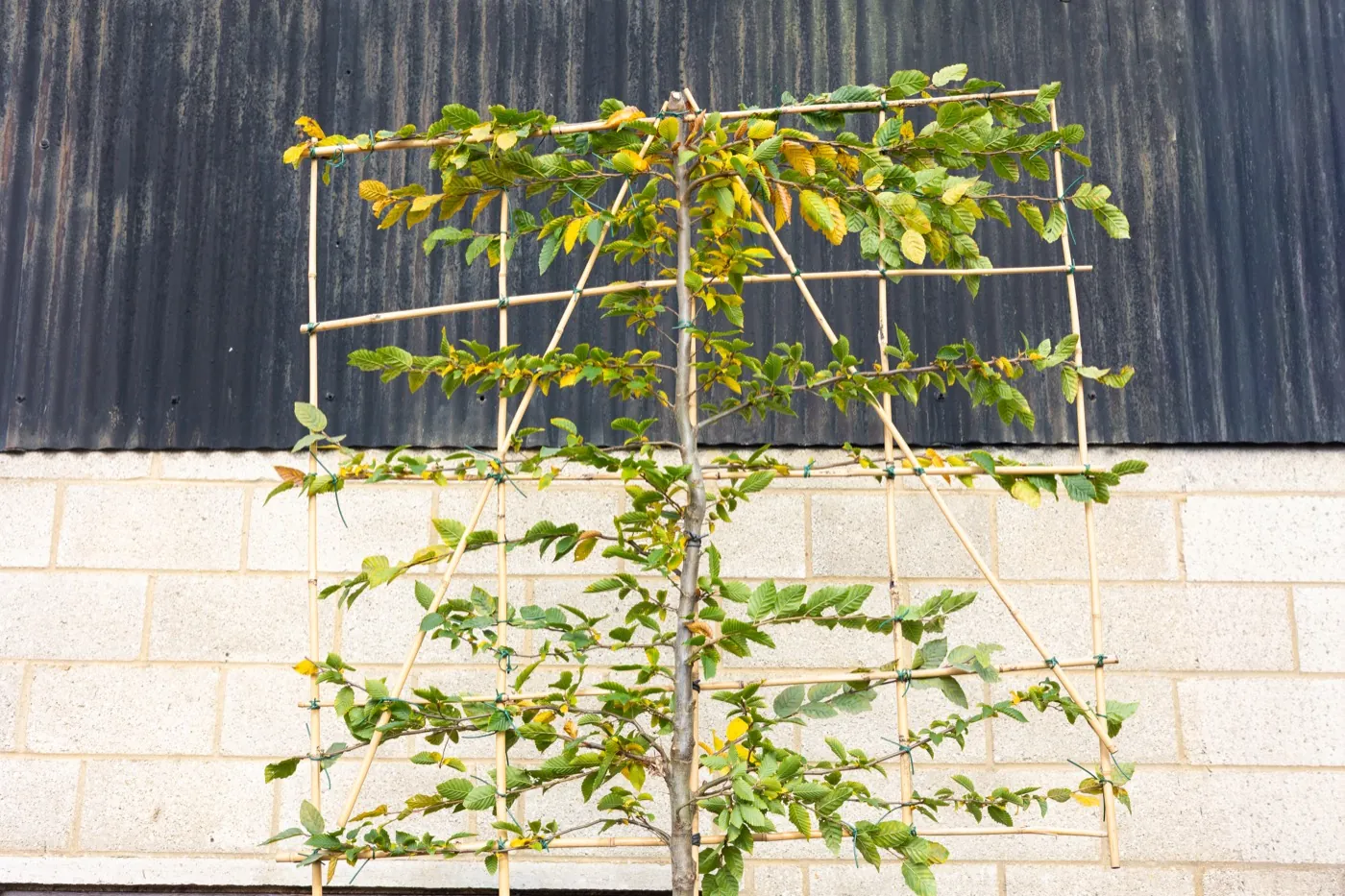
Due to Hornbeam’s (Carpinus betulus) ability to survive anywhere, it has become a cornerstone for wildlife in British gardens, providing shelter for birds, hedgehogs, rodents and all kinds of creatures. It can be used for a number things, such as hedging, pleached or full standard screening, its architectural features or topiary such as bonsai, columns, pyramids, panels and is great in a woodland setting.
Hornbeam (Carpinus betulus) likes to be positioned in full sun to dappled shade and can be spaced 3 every 2 metres in a hedge. You should not double hedge hornbeam. Architecturally, it will need little to no pruning, however as a hedge it should be cut back once a year before the leaves change colour and fall, generally, September is a the best time to do this.
Historically, hornbeam has been pollarded and coppiced for firewood and its wood has been used for pianos for its boney qualities. The largest recorded Hornbeam in recent history was at Studley Royal, Yorkshire, 90 x 8.5ft in 1958. Once established, it grows at 20-40cm a year reaching over 12m with a spread of over 8m after 50 years.
Hornbeam (Carpinus betulus) is often compared to Beech (Fagus sylvatica) due to their similarities and often it is hard to tell the difference. The main difference is the leaf. Hornbeam leafs up in early spring and has an rough, ribbed leaf whilst Beech’s (Fagus sylvatica) is much smoother leaf, holding old leaves until May when they are pushed off by the new growth. We have
|
Hornbeam (Carpinus betulus) |
|
|
Rough, ribbed leaf |
Smooth |
|
Holds leaf well, but will loose it during the winter |
Holds leaf until May when it is pushed off by new growth |
|
Leaves start to appear in early spring/March |
New leaves in May |
|
Establishes quickly |
Slow to establish, takes at least one year to start growing above ground |
|
Can tolerate water logged conditions |
Not as good in waterlogged conditions |
It goes well with mixed in with grasses, salvias and other tactile and plants which supply movement.
Maintenance/pruning
Dimensions in Favourable conditions
Growth Rate
Conditions
Light conditions
Hardiness
Suitability for animals and wildlife
General information
Every plant we sell is backed by four decades of growing. Tell us about your garden and we’ll tell you honestly whether this is the right plant for it.
Get in touch HedgeXpress