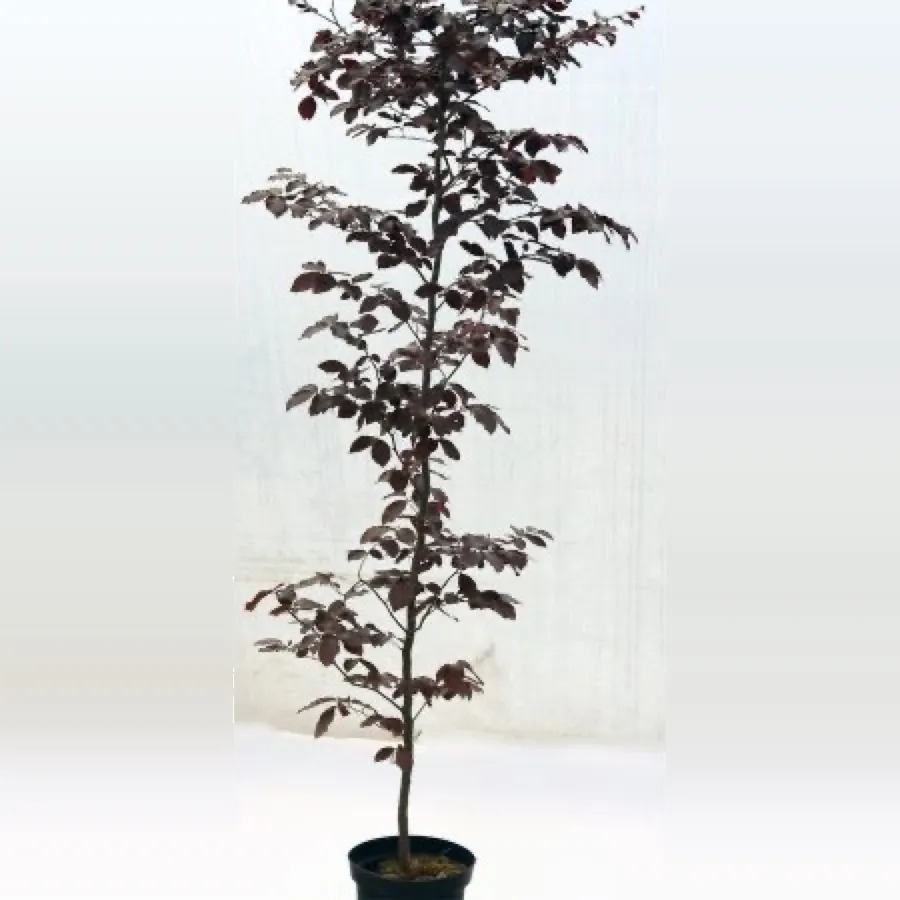
Being a young plant, this size of Purple Copper Beech hedging will grow away quickly to give a beautiful, bold copper garden hedge against which many plants will contrast well.
Container grown Purple Copper Beech in a variety of sizes
Our recommendation is to space each plant 65 centimetres apart.
Free click & collect from the nursery, or delivery on larger orders.
Purple, Copper Beech (Fagus sylvatica purpurea) is a versatile, hardy, sophisticated, tall tree, capable of forming a hedge. It is a naturally occurring variant of Beech (Fagus sylvatica) , capable of supplying privacy, reducing noise pollution and providing cover for local wildlife. At HedgeXpress, we class Purple Copper Beech (Fagus sylvatica purpurea) as semi-evergreen as in sheltered positions it is capable of keeping its old leaves until May (a process called marcescence), when the new copper coloured leaves push off the old, coppery brown leaves. Over the course of the year the leaves progress becoming a lighter shade of purple. This ensures screening is maintained throughout the year. The leaves are ovular shaped with a criss cross pattern but are much smoother than Hornbeam (Carpinus betulus).
Purple, Copper Beech (Fagus sylvatica purpurea) is capable of growing up to 50m tall and can form huge hedges. This stunning native tree has been an essential part of British landscaping for years and was incredibly important in the 17-19th century until it became almost as popular with the Grey Squirrel. It is possible to pollard and coppice Purple, Copper Beech (Fagus sylvatica purpurea), as a result of this it will become much wider. The widest of these stretch up to almost 10m wide at chest height and is capable of surviving a hard pruning, making it easily manageable and can be maintained easily between 1-5m. In a hedge, prune in August to best maintain the leaves. As a tree prune in late Autumn to Winter.
Purple, Copper Beech (Fagus sylvatica purpurea) is generally not fussy about the soil type, whether it be chalk, loam or sand providing it is not heavy and waterlogged. Beech grows very straight and has noticeably smooth, grey bark and when established, it can grow between 30-60cm annually. You can expect between 10 x 6m over 20 years in good growing conditions. Though it can take a while to establish, it is much quicker to do so when planting potted beech; try not to move the plant around the garden much as you may be waiting a while for it to get going again.
Purple, Copper Beech (Fagus sylvatica purpurea)makes for a resilient plant or hedge, capable of being exposed to harsh winds , making it a perfect windbreak supplying shelter for your garden and local wildlife. It can withstand frosts down to -20C, having a RHS hardiness rating of H6. It is native to much of Europe and Turkey, making its way to Southern England in the last Ice Age it is suited to full sun or shade, though growth will be much slower in deep shade and it may well revert to normal green Beech.. Many of the Beech forests of Europe have been deforested over the years. Beech is monoecious, meaning it has both sexes of flowers on the tree, producing catkins in the Spring.
Interestingly enough, Purple, Copper Beech (Fagus sylvatica purpurea) is edible and can be eaten raw in a salad whilst the leaves are still young. The leaves can also be used to create alcohol called Beech Leaf Noyau. Beechnuts or mast can be eaten by birds or other animals and is considered to be friendly to horses and other livestock.
Key information
Growth rate
Light Levels
Growing conditions
Max Dimensions
Pruning
Hardiness
Toxicity
Buying a hedge
Beech Hedges and Wildlife
FOOD
Birds: The Beech nut is an important food for many species including Great Tit, Jay, Great Spotted Woodpecker, Nuthatch and Siskin. These are produced on female plants and appear after around ten years. Mammals: The Beech nut is equally popular with small mammals including mice, squirrels and – importantly -rare voles. Insects: Beech foliage is eaten by the caterpillars of several moths, including the barred hook-tip, clay triple-lines and olive crescent.
SHELTER
Birds: If trimmed in early August, a Purple Copper Beech hedge will keep its leaves, offering privacy to humans and an excellent habitat for garden birds. Mammals: The thick shelter of an established Beech hedge offers a wide variety of mammals both temporary shelter or a home Insects: Over 60 insect species have been recorded living in Beech
MISCELANEOUS
If you are planting a longer Purple Copper Beech hedge, then do consider letting one, two or more of the plants grow as a tree. A Beech left to its own devices will reach c.4m after ten years. Not only will your hedge become a domesticated hedgerow, once the trees grow taller than the hedge, they will start to provide an even richer habitat for hole-nesting birds, wood-boring insects and a home for a broad selection of fungi, mosses and lichen.
Every plant we sell is backed by four decades of growing. Tell us about your garden and we’ll tell you honestly whether this is the right plant for it.
Get in touch HedgeXpress