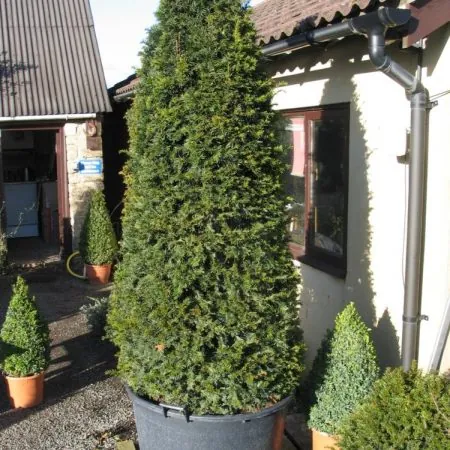
Yew is native to the UK and is shade tolerant. It is easy to manage and thus makes an ideal plant for topiary. It is long live and therefore if looked after correctly will pay heavy dividends, supplying great scenery and is capable of directing your vision to a picturesque back ground.
This plant is currently out of stock — tell us what you need and we’ll let you know as soon as it’s available again.
Yew Cones are incredibly smart and prestigious and can guide the eye towards a desired view or location. For instance a pair of them could guard a door or a line could guide you to scenic view. They are particularly popular in national trust houses and large manor houses.
Yew (Taxus baccata) otherwise know as English or common Yew is an elegant, sophisticated, bushy tree which is capable of being kept, quite contently in a variety of shapes being pruned continuously to the same dimensions making them the perfect candidate for topiary and are particularly popular with the National Trust.
The flowers whilst insignificant allows them to produce lovely red fruit on the female plants which supply a striking contrast with the foliage,
During the spring, Yew (Taxus bacatta) produces lovely, light green foliage which fades, becoming darker towards and during the winter. The fresh new growth is a striking look, along with its incredibly versatile qualities makes it one of Julian’s favourite plants. Allowing it to be planted anywhere from full sun to deep shade.
Yew (Taxus bacatta) is resilient hedge, able to withstand extreme weather on exposed sites. It is native to Europe, parts of Asia and North Africa. Due to its ability to withstand extreme climates the RHS have given it a hardness rating of H7. This means it is hardy in the severest European continental climates (< -20). Birds love the shelter they survive and love eating the berries.
Yew (Taxus bacatta) has an ultimate height of over 12m, spreading to in excess of 8m, growing 20-40cm a year. It is the longest living native tree in the UK, the living specimen in the UK is found near Swansea. The “ 60-foot-wide yew tree sits in the grounds of St Cynog’s churchyard near Swansea in Wales. Recent DNA and ring-count testing shows the tree to be more than 5,000 years old, making it older than the Great Pyramid of Giza”.
The most complete set of Yew (Taxus bacatta) trees is found in Kingly Vale on the South Downs, located on a steep hill. Yew’s love free draining soil and cannot stand being sitting in water for long periods of time. The steep hill in Kingly Vale in this case allows the water to drain freely, allowing them to thrive.
Yew (Taxus bacatta) is not friendly to livestock. Its foliage and seeds contains taxine, making them poisonous. Though the impacts of this varies depending on how dried out it is, the state of the stomach and so on. Though despite this, it has many wonders to it to, being used to treat both Breast and Ovarian cancer. These can be collected by companies such as Friendship Estates to be used in pharmaceutical drugs.
Yew (Taxus bacatta) may suffer from non fatal bronzing in winter.
Maintenance/pruning
Dimensions under favourable conditions
Growth rate
Conditions
Uses
Every plant we sell is backed by four decades of growing. Tell us about your garden and we’ll tell you honestly whether this is the right plant for it.
Get in touch HedgeXpress